How I say the Bank withheld information from the Ombudsman
The missing enforcement record
The Service asked for the full account history - and then decided without it. For my complaint, I say the earlier enforcement history was part of the relevant background. Many underlying demands, threats and instructions were not reproduced in the file disclosed to me. How could the fairness of the Bank’s treatment be properly assessed without addressing that missing history?
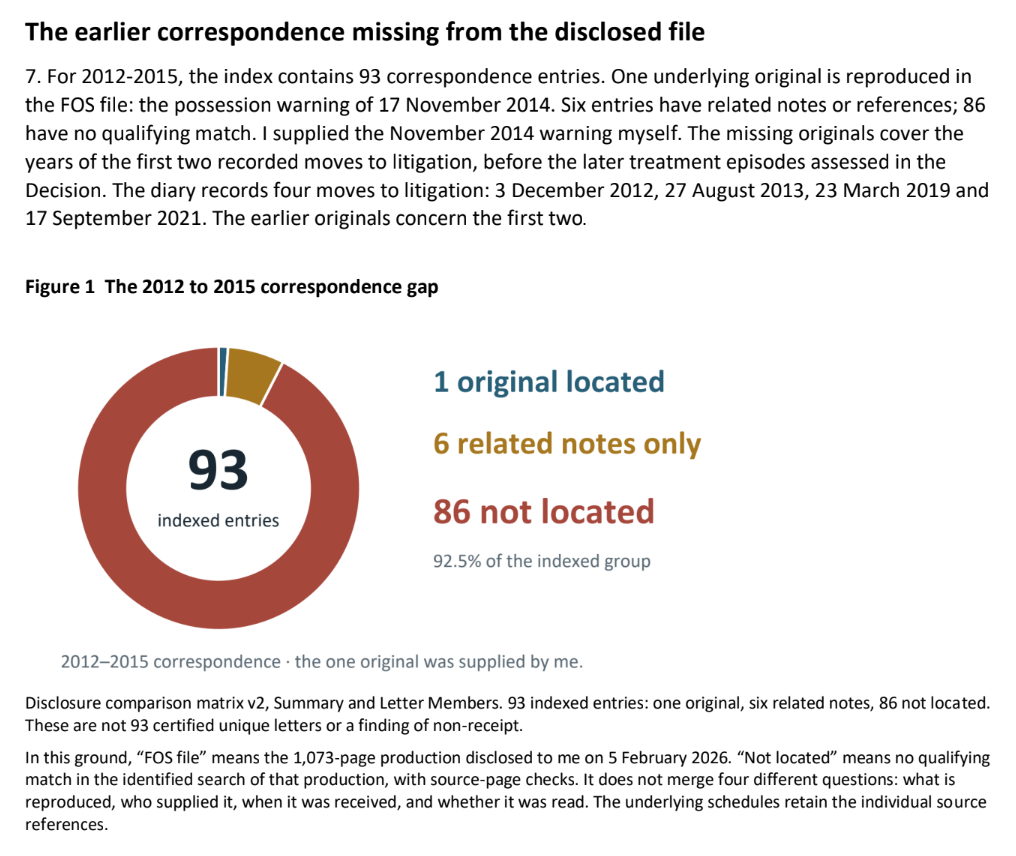
For 2012–2015 alone, 63 distinct enforcement letters were not reproduced as originals in the disclosed FOS file. Five of them were represented only by related notes or references. Those 63 letters form part of the wider figures below.
I compared the Co-operative Bank, Topaz Finance and Financial Ombudsman Service disclosures, reconciled duplicate copies and incorporated subsequent document matches. Within the reviewed records:
2012–2022: 89 enforcement letters or threats lacked original copies in the disclosed FOS file, rising to 108 including recurring demands.
Across the full pre-decision record: 92 enforcement letters or threats lacked original copies, rising to 123 including recurring demands.
Each figure includes the five letters represented only by related notes or references. These are counts from the reviewed document schedule, not a claim that every letter ever issued has been identified.
These figures exclude duplicate copies and do not count routine printed warnings—such as “Your home may be repossessed”—as separate enforcement letters or threats.
My case is that this was concealment of a material enforcement history. I say demands and enforcement for arrears that had been fabricated caused serious harm. A decision based on such an incomplete presentation cannot safely stand without the missing record being addressed.
The 2017 escalation and its consequences
In March 2014 I left my home to live in my buy-to-let flat in the centre of Cambridge because I couldn't cope with all the letters, repossession threats, daily text messages, relentless calls on my home phone number, field agents banging at my door. My home stood empty, my mental health deteriorated, and I paid both mortgages. In 2017, the Cooperative Bank stated that they were going to repossess the house, but only after they demanded that I be put on a "plan" for owing them £439.27 in arrears that the Bank’s own later reconstruction shows did not exist: 9 January 2017
The Bank’s call note · 9 January 2017
"Incoming call : Customer - TCF-Mr Care- N/A Past- Was off work sick in Decem ber with Celulitis. Mr is a self-employed Paramedic who is only paid when he works. Present-DCP: £500.00 Auth: 806135 He is now back at work but his shi fts and therefore his payment pattern is very erratic. Told him we need to do an I&E to put him into a formal repayment plan. He said this will be very di fficult to do due to his work and payment pattern. Mr intends to pay the rema ining £439.27 of his arrears on 20/01/17. Told him there is another payment d ue 22/01/17. He will have a better idea of his work and income by then. Inf h im of ADI/CR/Letters/phonecalls. Future- Mr to call 22/01/17 with payment of £439.27. Challenges-N/A Agreed Actions- As future Next Steps- As future."
What the Bank wrote
16 February 2017 E-MAS-18: Possession warning.
It says:
“Should we not be able to agree a repayment plan then consideration will need to be given to instructing our solicitors to commence action to obtain possession of your property.”
It immediately adds:
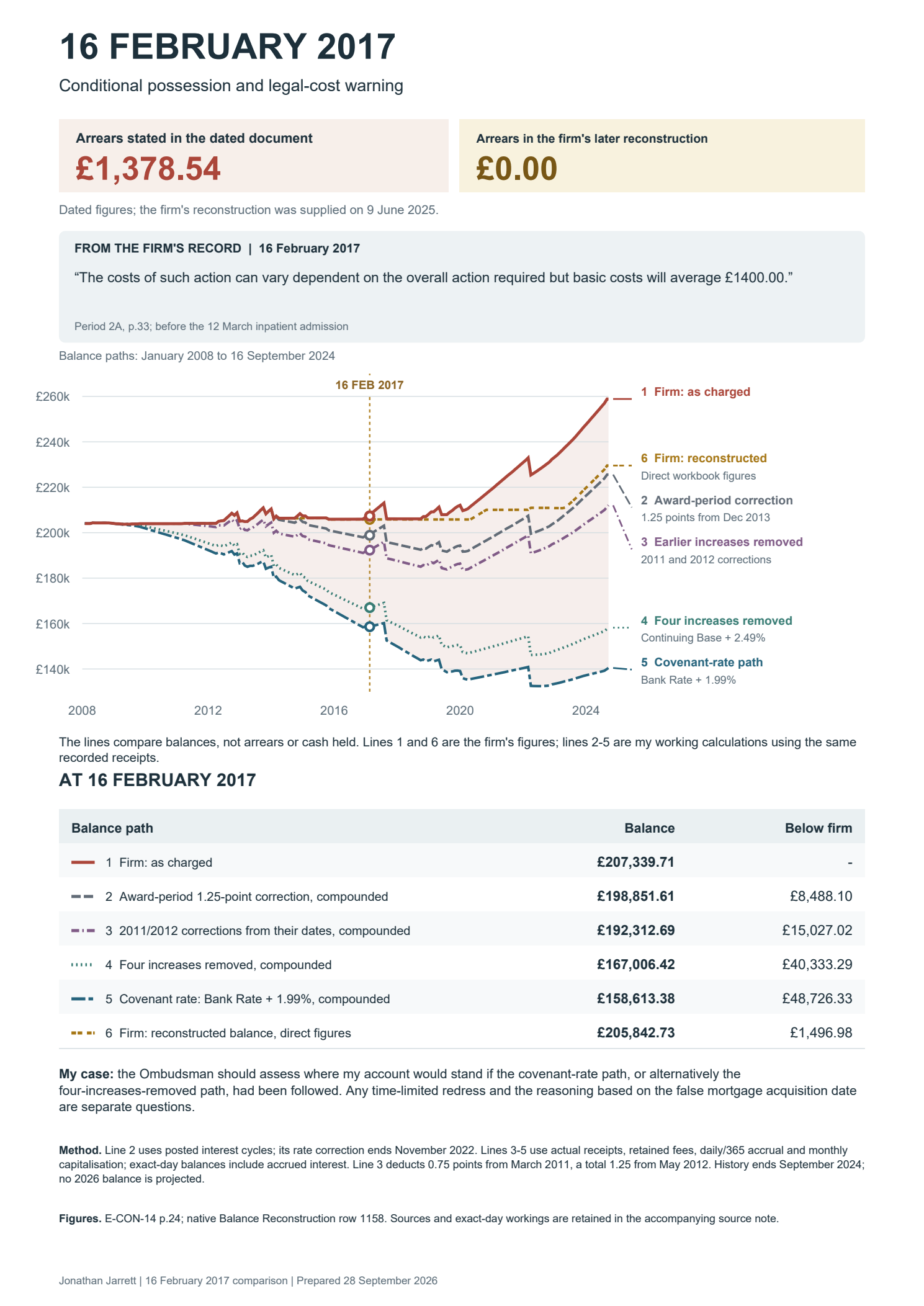
“The costs of such action can vary dependent on the overall action required but basic costs will average £1400.00.”
What the Ombudsman found
The Ombudsman’s final decision, page 14, says:
“I’m not persuaded MAS5 was threatening to repossess Mr J’s home.”
And:
“There is no evidence of MAS5 saying it was looking to take repossession or start legal action…”
The financial position at the February 2017 warning
The January call note demanded £439.27. By the 16 February 2017 possession warning, the stated arrears were £1,378.54. The Bank’s later reconstruction records £0 arrears on that February date.
Existing calculation prepared 28 September 2026. The six lines compare mortgage balances; the two boxes at the top compare arrears on 16 February 2017. Lines 1 and 6 are the firm’s figures; lines 2–5 are my working calculations using the same recorded receipts. The graph retains its calculation methods and source references.
The Bank did not provide the 16 February 2017 letter; I did. It was only in my part of the FOS file. The 2017 escalation has to be considered in the context of the 92 enforcement letters or threats, and 31 further recurring demands, that I say the Co-operative Bank concealed, and of the daily text messages and phone calls that do not appear in the records.
The consequences and the corrected account
Following all this pressure, I was admitted to hospital on 12 March 2017 after a serious deterioration in my mental health. On the Bank’s own reconstruction, the account had no arrears, or was in credit, every day from 12 March 2014 to 21 April 2023. That reconstruction starts only in December 2013, the Service’s cut-off, which I dispute. Take the 2011 and 2012 increases off from when they were made, and on my calculation the account never reached the three months’ arrears the Bank itself used as its trigger for litigation. Any debts I had need to be looked at in the context of the costs I was carrying: two mortgages, two council tax bills, two electricity bills, and any borrowing taken on to pay them.
We need to look at what I was charged above the contractual SVR, which the investor materials call “high excess spread”. From 2015, on the Bank’s own documents, that margin went to the securitisation investors, not the Bank. We also need to look at the regular threats of enforcement that were made for arrears I didn't owe and that were not in the file the Ombudsman had. So who received the money? →
My case is that there were never any true arrears. The arrears on the Bank’s paperwork arise only from the rate it charged: the four increases, and a rate above the restrictive covenant’s cap. Even with its limited correction, the Bank’s own later reconstruction shows no arrears, or a credit, every day from 12 March 2014 to 21 April 2023. On my case, what was treated as forbearance was the Bank holding back from arrears that its own charging had created, and the enforcement was for arrears that were not owed at the correct rate.
The Bank was very keen to tell the Ombudsman about my medical history before I took the mortgage out. Of course it never knew that I would be reading the file one day. I have put together for the Service a brief history of my work, earnings and medical records, where the matters that confused the Bank are clarified.
The question for the Service now is why a vulnerable customer, who had built a good career despite some earlier setbacks in life, was pursued relentlessly for arrears that, on my case, were not owed, until he lost his career.
If this reaches the Administrative Court, I hope it will also see what happened to other customers in these mortgage books, and what lessons can be learned.
I ask the Service to address my concerns about financial abuse and vulnerability under its published safeguarding policy.
Financial Conduct Authority material
Withheld
Information the Bank gave the Financial Conduct Authority is relevant to my case. I have asked for permission to share it with the Service; otherwise, to do so would be a criminal offence (FSMA 2000).
In April 2026 I told the Bank’s solicitors in writing that information the Bank had given the FCA about me was materially false. Their reply of 28 April 2026 did not answer that point.
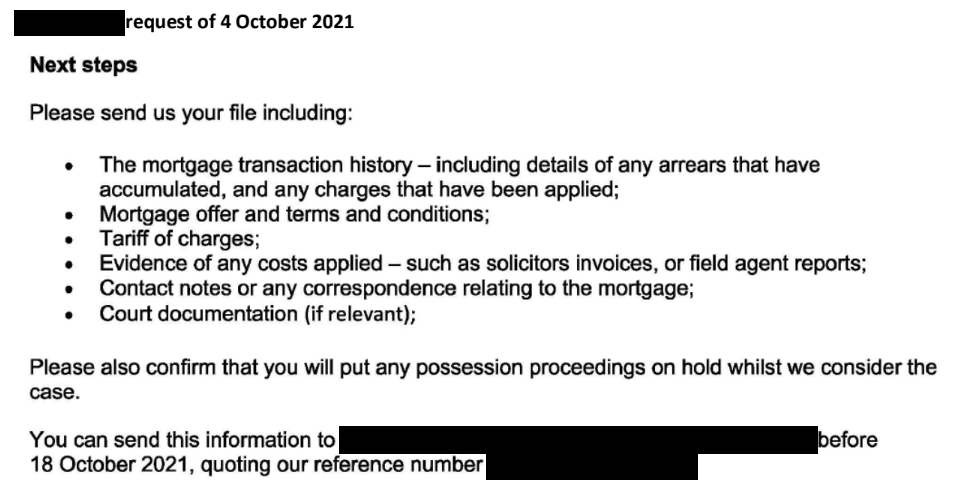
I say the Bank withheld evidence of the enforcement and harassment I experienced before 2019, concealing its scale and its impact on my mental health. The comparison below shows what was located in the disclosed FOS file. The missing records are documentary gaps; my contention about deliberate withholding rests on the wider evidence, including what the Service asked the firm to supply.
The earlier enforcement recordThe comparison retains the distinction between indexed entries, original documents and related notes.Open image at full size ↗What the Ombudsman requestedThe Service’s request of 4 October 2021 included contact notes, correspondence and relevant court documentation.Open image at full size ↗
My position is that the Ombudsman was misled by an account of support and forbearance which did not confront the disputed arrears, the inaccurate employment history or the full enforcement record. Those matters must be assessed together.