I contend that the Bank knew it was maintaining charges beyond its entitlement and pursuing arrears that were not owed. The question is particularly serious at the time of my 2019 illness and enforcement. The evidence is the combined record: what the Bank knew about the restriction, what it chose to charge, what that income generated, and the account it later supplied.
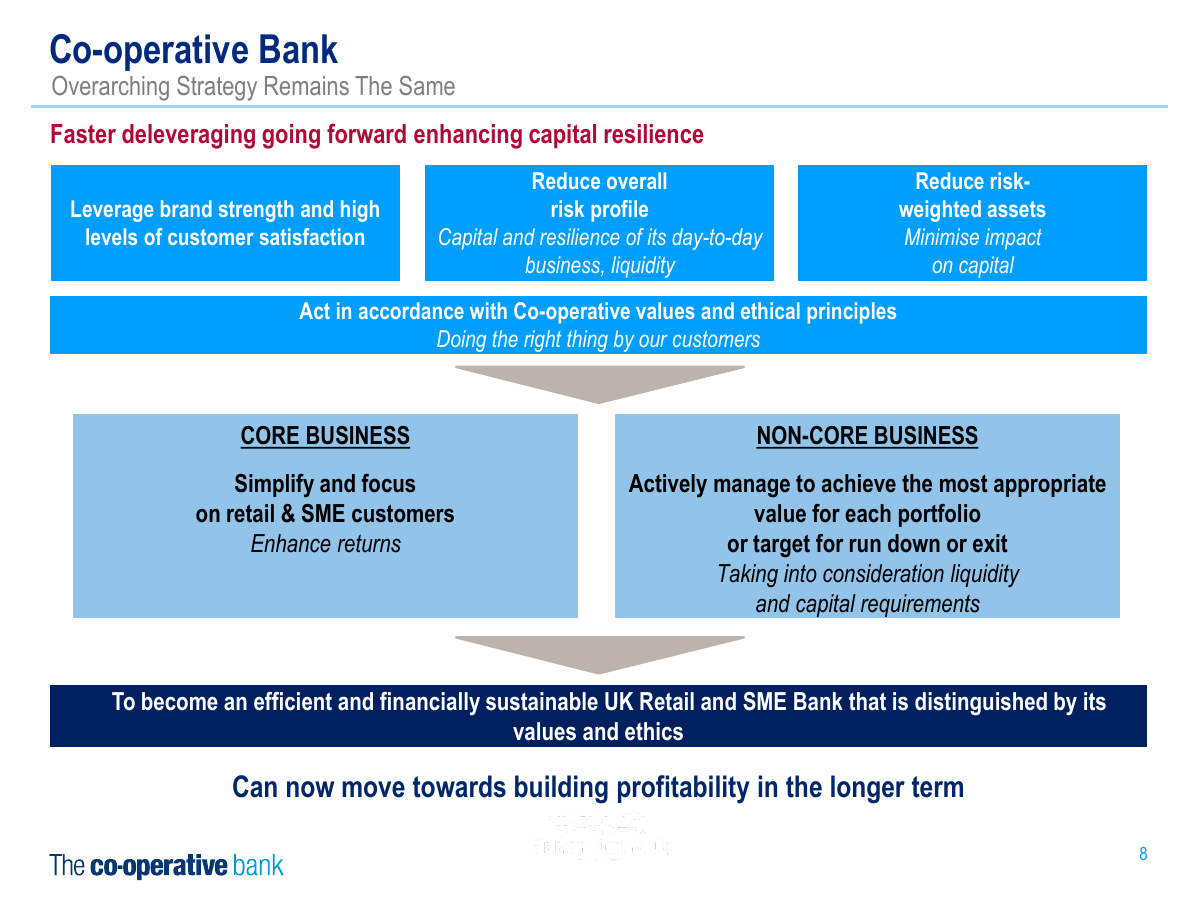
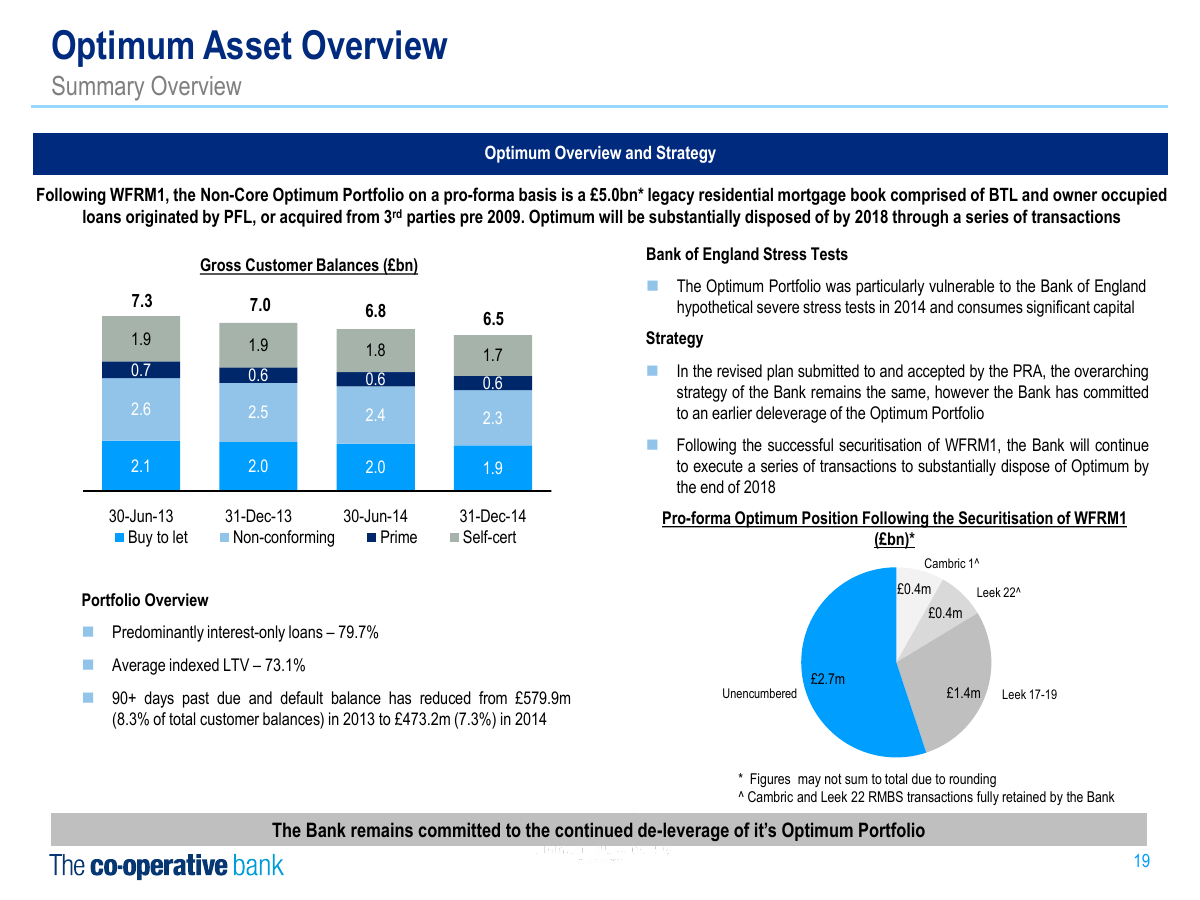
The Bank explained its strategy to investors at Global ABS in Barcelona in June 2015. Its presentation said the non-core business would be actively managed to achieve value or targeted for run down or exit. It then identified the objective for the Optimum mortgage book: substantial disposal by the end of 2018. This was a planned commercial strategy, presented to the investment market.
Yet the Bank told me in 2021, as it charged 5.25% over base rate "We have done our utmost to support you and help you keep your home". One bank, two audiences, same facts, different story.
That is the context in which I say my treatment must be examined. The Bank was seeking value from a mortgage book it wanted to exit, while customers faced high rates, demands and pressure to sell. Finding that strategy in a specialist investor presentation is different from being told, as a borrower, how your mortgage would be managed. The question is when I knew—or could reasonably have understood—what that strategy meant for my mortgage, not simply whether a document existed somewhere online.
My case is that the Bank pursued that objective at borrowers’ expense: extracting income while we could pay, then applying pressure towards sale or possession when we could not. Higher interest payments generated income; selling the loans realised value; repayment through the sale of borrowers’ homes reduced the book. Those routes could all serve the same policy. In my case, the Bank promoted an Assisted Voluntary Sale and pursued enforcement over arrears that even its own later, limited reconstruction removed. Calling the book “non-core” did not give it permission to overcharge customers or enforce debts that the corrected account did not support. “Managed for value” leaves an obvious question: value for whom?
They knew what these rates were generating
I contend that the Bank knew it was charging more than it was entitled to charge. It knew the mortgage restrictions, set the rates and held the account information.
My completed Warwick 2 allocation shows how an SVR minority could supply most of the surplus. For the quarter associated with the 21 March 2019 residual payment, SVR loans were about 20.5% of balances but supplied an estimated 66.5% of the modelled surplus after the transaction’s higher-priority costs.
About one-fifth of balances. About two-thirds of modelled surplus.
SVR share of balances 20.5%
Estimated SVR share of modelled surplus 66.5%
Warwick 2: quarter associated with the 21 March 2019 payment. Allocation estimate using snapshot rates and costs allocated evenly across mortgage balances. Each track represents 100% of its measure. Read the figures and calculation method →
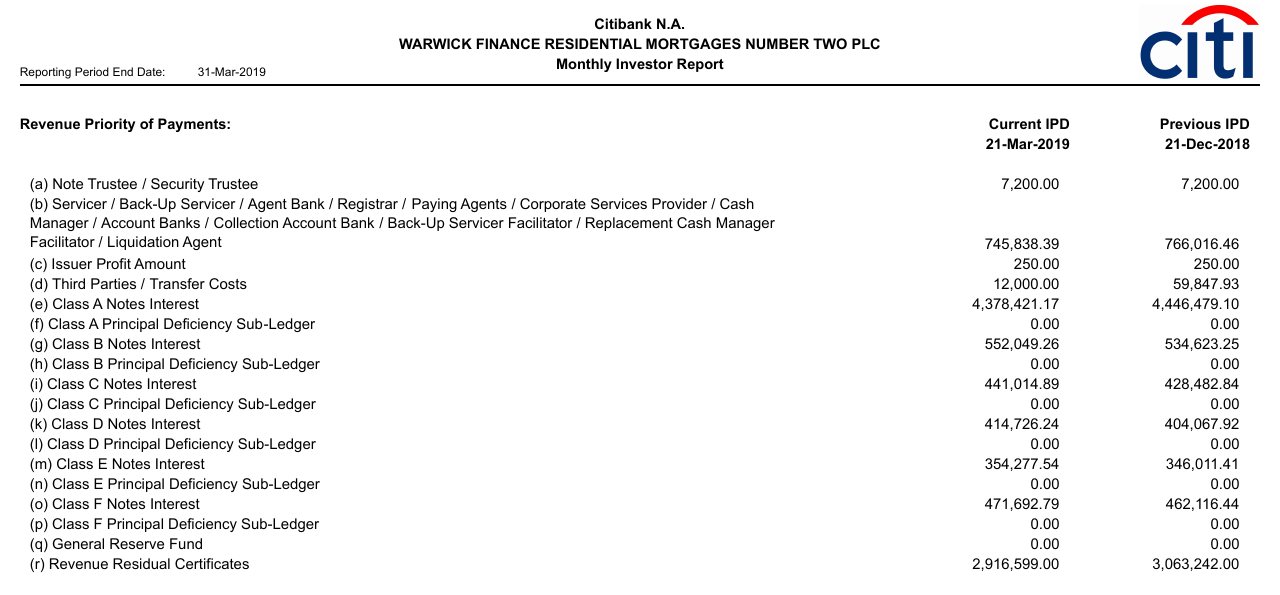
On 21 March 2019, the transaction paid £7,377,470 in note interest and other transaction costs, followed by £2,916,599 to revenue residual certificates. A residual payment is the amount distributed after the transaction’s higher-priority payments. Recorded cumulative residual payments had reached £51,028,115 by that date, before my April enforcement and injury. These are transaction distributions; I do not describe them all as Co-op profit or as money exclusively from SVR borrowers.
The Bank had already realised value from that future income. The residual certificates were sold to third-party investors when Warwick 2 closed in September 2015. I contend that my rate remained high because the Bank had already sold rights to that future income—income which, on my case, it knew it was not entitled to collect. Reducing the rates would reduce the purchasers’ expected residual income. Read alongside the later disclosures and analysis, this forms part of the new evidential picture I ask the Service to assess. The Bank had sold the income stream, while borrowers still had to make the payments. Selling that income did not create a right to keep charging it.Read the 2015 sale record →
I suffered serious harm while the Bank pursued arrears that even its later limited reconstruction removed. I rely on this income evidence alongside the restrictions, the firm’s own records, the challenges put to it and the newer disclosures—not as a report declaring the charging unlawful. The Bank could measure what those rates earned. What entitled it to charge them—and to pursue my home over the resulting arrears?
The corrected account and the actual covenant wording
The Bank’s June 2025 reconstruction showed nil or credit arrears from 12 March 2014 to 21 April 2023, including the 2019 and 2021 enforcement dates. Its July letter reproduced Clause 14 and identified the relevant 2006 transfer. The reconstruction changes the premise of the demands; the clause’s wording allows its obligations to be tested.
The Bank’s 31 July 2024 email in the FOS file used the false 2007 transfer account. Read together, the covenant wording, corrected account, investor reports and loan data reveal a different picture of the Bank’s business model and its dealings with me. That is the evidence I ask the Service to assess.
My allegation of knowledge comes from reading it with the firm’s restrictions, deliberate pricing decisions, its own underlying records and the materially false account supplied to FOS. I ask the Service to decide that combined inference.
The entitlement question
They knew the restriction and chose the pricing
The Bank’s own account of its earlier decisions
A constraint under conscious review by May 2008
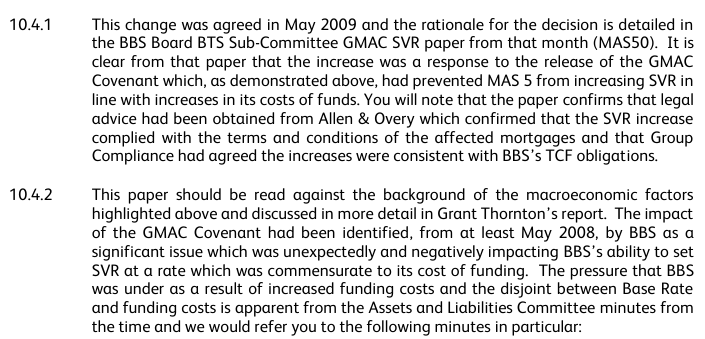
The Bank’s September 2022 submission says Britannia had identified the covenant as a significant issue from at least May 2008. It describes the May 2009 decision to raise the rate, and calls the protected rate an “artificially low SVR”. I rely on this as evidence of knowledge of the restriction and deliberate pricing. The 2009 decisions were made by MAS5 within Britannia, which merged into the Co-operative Bank that year; MAS5 then maintained the rates and enforced within the Co-operative Bank group.
The same submission says legal and Compliance advice supported the increases. That is part of the Bank’s defence and is retained in the extract. I ask for the underlying advice’s scope, the pricing paper and the alleged release to be properly addressed. Knowledge of the restriction is documented; knowing lack of entitlement is the further finding I seek.
E-FOS-15, pp.14–15, §§10.4.1–2 and 10.4.8; the Bank’s 16 September 2022 submission describing the earlier records.
Ground 5 · rate powers
A business objective did not itself authorise a higher rate
The cost-of-funds clause required the relevant change, or reasonably expected change, in the funds used in MAS5’s mortgage lending business. I challenge the acquired-business interpretation as well as the cost condition. An investigator in another case took a narrower view of “mortgage lending”; the later Davies decision took a broader view. Even on that broader view, it did not find the required MAS5 funding-cost justification.
Published decision DRN-4427884, pp.21, 31 and 49 → This is a 2023 decision in another borrower’s case, not proof that this finding had been given to the Bank before April 2019. It also made separate fairness/redress findings.
The borrower’s contract still matters
Investor requirements could not enlarge my obligations
The Warwick 2 servicing agreement restricted rate changes to reasons permitted by the mortgage conditions. Its reset machinery also required compliance with those conditions and applicable law. The Bank’s desire for income must therefore be tested against the rights it actually acquired.
My quoted rate, Bank Rate + 1.99%, sat just within the covenant’s 2% ceiling. I have not conceded a valid release of the covenant. The complete agreement and alleged release remain issues requiring determination.
My case is that the Bank used its rate-setting power for an improper purpose: maintaining charges beyond its entitlement and pressing borrowers towards sale or possession to deliver its run-down strategy. The purpose for which it used the rate must be examined alongside the express contractual restrictions.
I rely on Braganza v BP Shipping Ltd [2015] UKSC 17 in challenging the Bank’s exercise of its contractual rate-setting discretion. Paragraph 21 discusses Paragon v Nash and the limits on mortgage-rate powers. Paragraphs 24 and 30 address relevant considerations, rational decision-making, good faith and consistency with the purpose of the contract.
My case is that the unusually harsh enforcement and the aggressive, relentless, targeted bullying were used to extract high interest payments beyond the Bank’s entitlement and drive borrowers towards sale or possession. The three-month litigation trigger must be considered alongside the enforcement letters I say the Bank concealed from the Service after it had been asked to provide the full documentation. I rely on that conduct and the way the record was presented as evidence of the purpose for which the Bank used its powers.
The completed Warwick 2 allocation adds the commercial connection: the SVR minority, about 20.5% of balances, supplied an estimated 66.5% of the modelled surplus for the quarter associated with the 21 March 2019 payment, with costs allocated evenly across balances. That calculation sits alongside the corrected arrears history, the Bank’s knowledge of my vulnerability, the documentary contradictions and the specific new evidence set out in my reconsideration request.
The Service must assess this evidence together: what the Bank knew, what it sought to achieve, what it took into account, and what it left out. My contention is that the combined record shows an improper use of the rate-setting power and enforcement of charges the Bank knew were not properly due. I ask the Service to determine that contention on the full evidence.
The Bank told investors in June 2015 that non-core portfolios would be managed for value or targeted for run-down or exit, and that Optimum would be substantially disposed of by the end of 2018. These were planned commercial objectives.
Global ABS, Barcelona, June 2015, slide 8; E-SEC-17 p.2.Optimum overview and strategy, slide 19; E-SEC-17 p.3.
Income while loans remained, sale of the loans and repayment through borrowers’ sales could all reduce the book or realise value. My contention is that the firm knowingly pursued that objective through charges beyond entitlement and pressure towards sale or possession. The strategy documents establish the objective; my account records provide the connection to the demands against me.
The report for the period ended 31 March 2019 records the payment made on 21 March and the month-end rate-group balances. The matching loan data supply the rates used in the calculated gross-interest comparison. An SVR is a lender-set standard variable rate; the tracker groups follow their named benchmark plus their contractual margin.
September 2015 · the sale of future income
The Bank had already received value upfront
The Warwick 2 prospectus says that the sellers received the residual certificates as part of the consideration for the mortgage portfolio and would sell them to third parties at closing. The Bank’s annual report confirms that Warwick 2 completed on 25 September 2015. The sale converted rights to future receipts into value upfront; subsequent distributions to purchasers do not erase that earlier benefit.
The revenue certificates entitled their holders to the remaining revenue after higher-priority payments. Lower mortgage income would reduce what was available to those holders. I rely on the sale as part of my case about the incentive to maintain higher charges, subject always to the rights in the borrower’s mortgage contract.
Read the prospectus’s statement that the certificates would be sold
Warwick 2 prospectus, 22 September 2015, printed ii and 72 (E-SEC-06a p.2; E-SEC-06b p.4). Bank Annual Report 2015, printed pp.19 and 138 → The accounts report combined Warwick 1/2 cash proceeds and an overall net disposal loss; they do not isolate a residual-certificate sale price or establish that those certificates sold at a premium.
March 2019 investor report, p.4; current payment date 21 March 2019. Staff contact footer omitted.Same report, p.14, rate-type table. The average rates and gross-interest share come from the matching loan data, not this table alone.
Read the calculation and payment basis
Swipe the table sideways to see every column →
Mortgage group
Share of balances
Weighted average rate
Calculated gross annual interest share
Bank Rate trackers
50.80%
2.70%
37.44%
LIBOR trackers
28.76%
3.68%
28.92%
SVR loans
20.45%
6.03%
33.63%
March 2019 loan data, WF 2 Current, columns AP/BQ/BR; completed September 2026 analysis and E-ANA-10. Gross interest is the annualised sum of positive current balances multiplied by current rates. The bank-rate negative balance is retained in reported balances but excluded from positive-balance rate-weighting. Rounding may prevent displayed percentages adding to exactly 100%. This is a snapshot calculation, not actual collections.
The 21 March payment table gives £6,612,181.89 of note interest and £765,288.39 of other higher-priority payments: £7,377,470.28 in total, rounded to £7,377,470 on the homepage. The residual payment was £2,916,599. The cumulative £51,028,115 counts each quarterly residual payment once from December 2015 through 21 March 2019. Repeated appearances in monthly reports are not added again.
Who supplied the surplus? The completed E-ANA-12 allocation uses the average of November 2018 and February 2019 balances for the collection quarter, March snapshot rates, and the £7,377,470.28 of priority payments. Allocating those costs evenly per pound of mortgage balance gives an annualised cost of about 2.61%. The estimated shares of the modelled surplus are SVR 66.5%, LIBOR trackers 29.0%, and Bank Rate trackers 4.5%. The modelled quarterly surplus is approximately £3.00 million, compared with the £2.92 million actually distributed. This is a one-quarter allocation estimate, not cash traced to individual borrowers or an allocation of cumulative distributions. Source: E-ANA-12, pp.1–2, 25 September 2026; current Ground 6, p.5.
The report and data describe a mixed pool. They do not trace every pound of residual income to an individual borrower or establish that every SVR loan had my covenant protection. The recorded payments discussed here precede April 2019.
Underlying record: Warwick Finance 2 Monthly Investor Report Mar 2019, pp.4 and 14; matching monthly loan data; completed 13 September 2026 Warwick spread and mortgage-group review, now incorporated into current Ground 6. Return to the main knowledge argument and comparison →
The later investor disclosures
What Avon 1 and Avon 2 add
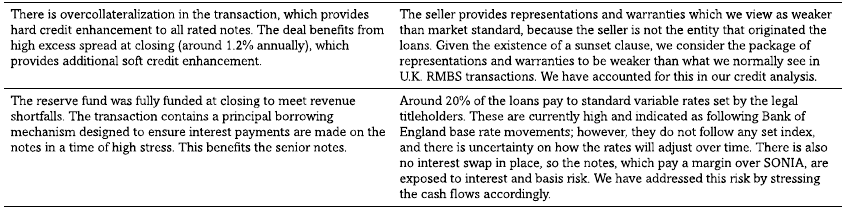
Excess spread was measured for the transaction
S&P’s 4 August 2020 Avon 1 report described high excess spread of around 1.2% annually at closing. That 1.2% was measured across the whole Avon 1 mortgage pool—not just the SVR loans. Around 20% of the pool paid high administered SVRs. S&P also explained that higher-paying loans defaulting or repaying early could reduce the pool’s yield.
My completed Warwick 2 allocation shows how an SVR minority could supply most of the surplus. For the quarter associated with the 21 March 2019 residual payment, SVR loans were about 20.5% of balances but supplied an estimated 66.5% of the modelled surplus after the transaction’s higher-priority costs. In that calculation, about one-fifth of the mortgage balances generated about two-thirds of the surplus. That is the disproportionate contribution I ask the Service to examine.
The 66.5% estimate is from E-ANA-12, the completed 25 September 2026 calculation incorporated into current Ground 6. It allocates costs evenly across mortgage balances and uses snapshot rates for the quarter. It concerns Warwick 2 in March 2019; Avon 1’s 1.2% is a whole-pool measure for a different transaction and date. Read the source figures and calculation basis →
Read the spread-compression passage
E-SEC-05, pp.3 and 11. This report concerns Avon 1; its metrics are not interchangeable with Warwick’s March 2019 payment.
The 21 upheld complaints: what is actually stated?
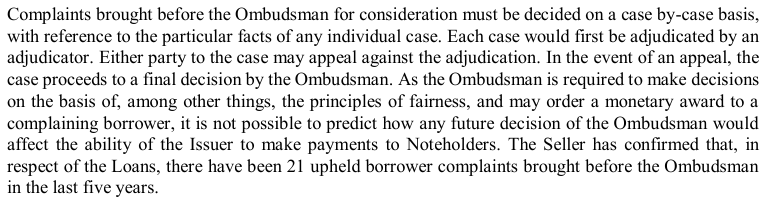
Avon 1’s prospectus, dated 31 July 2020, states that the seller confirmed 21 upheld borrower complaints concerning the loans in the previous five years. It does not identify their subjects or decision dates. I ask for them to be identified.
The 17 September 2020 Avon 2 prospectus also describes the risk of FOS decisions and reductions in variable rates. The FOS-risk passage checked does not supply the same 21-complaint count. I ask for the underlying complaints, findings and dates to be identified where they bear on the Bank’s knowledge.
Avon 1, printed p.323 (E-SEC-07 p.15). Avon 2, full PDF p.62 and printed pp.60–61 (E-SEC-16 pp.5–6). The date of a disclosure does not determine when the Bank first knew the facts it records. I rely on these disclosures as evidence bearing on earlier knowledge, including the five-year complaints history reported in Avon 1, and ask the Service to establish the underlying chronology.
The other sums added to my account
Late fees, insurance, visits and legal costs
The later full-account statements identify the following non-interest charges from inception. The comparison counts each movement once, keeps credits visible and compares Co-op and Topaz copies. The transaction rows run to 22 July 2025; the latest fee shown is 1 May 2025.
Swipe the table sideways to see every column →
Category
Debit entries
Gross debits
Credits or offsets
Origination fees
3
£665.00
£70.00
Insurance premiums
17
£767.22
£44.46
Insurance administration fees
3
£90.00
£40.00
Late-payment fees
15
£594.00
£594.00
Field-agent fees
4
£285.60
£0.00
Solicitors / agents costs
11
£2,481.60
£0.00
Unpaid-payment fees
4
£32.00
£8.00
Total
57
£4,915.42
£756.46
£4,915.42 debited; £756.46 in separate credits or offsets. These identify the historical charges to reconcile. They are not a calculation of today’s balance, compensation or the amount still recoverable. Ordinary mortgage interest, additional interest, principal and transfers are excluded.
Completed 20 September 2026 charge comparison; CH-001–CH-063. Co-op first split pp.1–29 and Topaz Batch 9 pp.92–120. The £40 insurance-fee credit is dated 5 June 2009 on the separate account statements and 26 May on both later full-account runs; the £8 unpaid-fee credit is dated 31 January 2014 on that account statement and 29 January on both later runs. The table retains the later-PDF dates without treating them as conclusive native posting dates.
Four weeks earlier, the Bank told investors
In September 2015 the prospectus for Warwick 2, a securitisation that included MAS5 loans, told investors that approximately 9,337 of 16,079 sub-accounts “are or could be affected” by “Conduct Issues”. These included fees “not legitimately charged” and customer detriment from “mortgage arrears handling (including forbearance)”.
Warwick Finance Residential Mortgages No. 2 plc, Prospectus, 22 September 2015; Master Definitions Agreement (“Conduct Issues”, “Affected Borrowers”). MAS5 is one of the Sellers.
The Bank had already refunded £594 in late fees
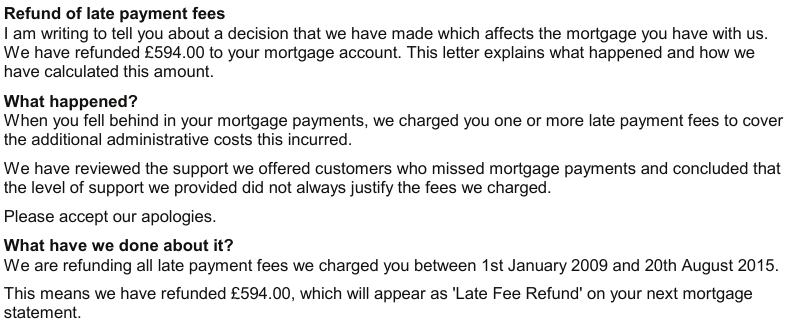
Its 19 October 2015 letter said the support provided did not always justify the fees and refunded £594. That is an identified concession about late fees, made before the 2019 enforcement. It is separate from the interest-rate dispute.
E-REG-04, p.1, cropped below address/account details. The later SVR settlement credit is a separate transaction and is not added to these six credits.
Insurance and interest need their own reconciliation
The schedule includes 17 insurance premiums totalling £767.22, a £44.46 premium credit, and insurance administration entries. I ask for the authority, policy dates, cover and supporting records.
The Bank’s refund Q&A says no interest had been charged on the late fees. The 2024 statement separately reports non-interest-bearing charges and additional interest. I therefore ask for itemised interest treatment.
Read the statement’s separate charges and interest headings
E-REG-04 p.2; E-STM-04 p.14. Some fee descriptions are less specific in the native export, and two fully cancelling pairs are absent there but retained in both full-account PDFs. The fuller 63-row comparison controls this table.
The 2019 and 2021 legal charges matter especially because the Bank’s own later reconstruction removes arrears at those enforcement dates. Insurance and other 2012–2013 entries must be assessed under the full account and their own contractual basis.
The decision I ask the Service to make
Join the knowledge, the income and the enforcement
I contend that the Bank knew the arrears it pursued against me were not properly due. The conscious pricing record, the income reporting and the later contradictions support that allegation together. I ask the Service to determine it on the evidence, including the underlying pricing approvals and the full historical calculation it requested.
The current Grounds 5 and 6 guide this evidence page. The contractual records, investor reporting, account history and my treatment must be assessed together.